
DFW Wants To Bling Out With Holographic Virtual Assistants, But I’m Thinking Most Airport Passengers Want Function, Not Form
March 30, 2026 by Dave Haynes
Airports are by their nature some of the most linguistically diverse places on the planet – especially major hub airports that handle a lot of international flights. So applying technology like real-time translation and AI makes perfect sense for airport operators who have questions from travelers coming at them 24/7, and not all in the common languages of that city or country.
Kiosks and larger touchscreen stations can do a nice job of fielding questions and relaying answers to travelers in their first language, and numerous airports – from Toronto to Taipei – have working solutions.
But what happens when form seems as, or perhaps more, important than function?

That would appear to be the situation with DFW – the mega airport in Dallas, Texas. Its operators have recognized traveler-facing staffers have a big challenge handling questions coming at them in all kinds of unfamiliar and uncommon languages, and are looking at real-time multi-lingual technology as at least one answer.
Except the airport wants the tool to be a Holographic Virtual Agent. DFW likes the idea so much it even gave the thing an acronym – HVA.
Hold please while I do a lengthy face-palm …
An industry friend sent me an RFP intro doc that DFW’s people have pushed out recently, looking for a vendor who can put this together for them.
The DFW Innovation team is seeking proposals from technology providers specializing in holographic display solutions enhanced with AI-driven multilingual and accessibility capabilities. The objective is to deliver an inclusive, interactive, and informative experience for all airport passengers through a Holographic Virtual Agent (HVA).
This solution will integrate cutting-edge holography with Artificial Intelligence (AI) and Large Language Models (LLMs) to serve as a real-time virtual guide capable of communicating with users in their preferred language.
The RFP also explains …
The Holographic Virtual Agent (HVA) initiative focuses on deploying advanced holographic technology to create an engaging, interactive, and universally accessible information experience. This virtual assistant will provide real-time guidance, airport-specific information, and interactive support to passengers in multiple languages across public spaces.
The virtual assistant thing is a totally sound idea, but the need for this to be holographic is baffling. As someone who has passed through a lot of airports over my career, I am pretty comfy suggesting the great majority of travelers won’t give a crap about the eye candy. They just need to find their gate, a lounge, a customer service counter or a time-killer place that has good beer on tap or decent bourbon on the shelf.
Let’s address the main issue – holographic.
The different technologies promoted at trade shows as holographic are not holographic. A transparent LCD in a display enclosure is not holographic. Those madly-spinning LED light rotors are not delivering holographic visuals. Same goes for near-transparent mesh LEDs touted as holographic and invisible. Nope. Nope. Nope.
To be holographic, they need to deliver dimension. Viewers need to be able to walk around to the side and rear and see an object or figure that has depth. These are just visual illusions that in a variety of ways create the illusion of an object or figure floating in free space or contained in a box that appears to have depth and shadows.
Being faux holographic like these things adds some short shelf life novelty, and a whole pile of extra cost. And very likely introduces complexity in production and ongoing management.
Samsung has started promoting an 85 inch “spatial signage” display that is a faux holographic unit with the added twist of a glasses-free lenticular lens. It cleverly does what Proto and some its copycats do using much less physical depth. So it is more like the thickness of a digital OOH media totem you’d see in a mall than the shower-stall form factor of Proto and the companies that have followed.
But the things cost $15K-$20K per unit. That’s many multiples the cost of a conventional 2D 85-inch commercial display. Its been a while since I heard the cost of a full-sized Proto unit, but I’m thinking it is even more than the Samsung units.
And for what?
This is not a new idea for DFW. It has had a voice activated virtual concierge station in a terminal since 2022, allowing lost/confused/frustrated travelers to walk up and get helpful information.
It looks/looked like this:
AI has made huge leaps in four years so it makes sense to do an upgrade that can do interactions in a preferred language, with snappy, accurate responses kicked backed in that language from an AI LLM. The holographic “ask” from DFW suggests the airport wants a friendly virtual human in life-size handling the interaction in real-time.
Presumably, as well, interactions will need to happen like the current one using voice AI, or a touchscreen keyboard. Voice can be pretty sophisticated and accurate now, but airports are LOUD places … so that will be a challenge.
DFW wants to pilot this in multiple locations around its passenger areas.
This, by the way, is what the UK firm Hypervsn is touting for airports, using its light rotor tech and tied in with the wayfinding firm MappedIn. …
Setting aside the Hamburg nightclub manager avatar look, and how that microphone wouldn’t last more than a day in a busy airport, I can get behind the core information delivery. But the teleportation unit thingie … another face-palm.
My free, unsolicited advice: forget the faux hologram thing and put the work and focus on the LLM and user experience. DFW could probably have several large format units mounted on support columns or walls, using conventional LCD displays, for the same cost as a single faux holographic thing. The avatar might not kinda sorta appear to be virtually there, but who the hell cares?
There is some research that suggests people are receptive to the “social presence” of avatars, though there is a delicate dance to do in delivering something that is near-human without being creepy or weird. They can work. The Iris avatar that DFW was using is a little unnerving, but passable. And it works just fine as a flat video file – you know … the viewing experience we have on every other device we use and watch.
I am not at all convinced it makes a lick of difference to up the capital cost and production budgets substantially to make the not-human greeter kinda sorta appear to be inside a box.
The absolute opposite of this sort of thing – which I like because I am pragmatic (and a proud simpleton) – is the use of transparent OLED at mass transport information counters in big cities like Tokyo and Seoul. There is a real person on the other side of a glass divider, but real-time translated Q and As are shown as text on the transparent screens.
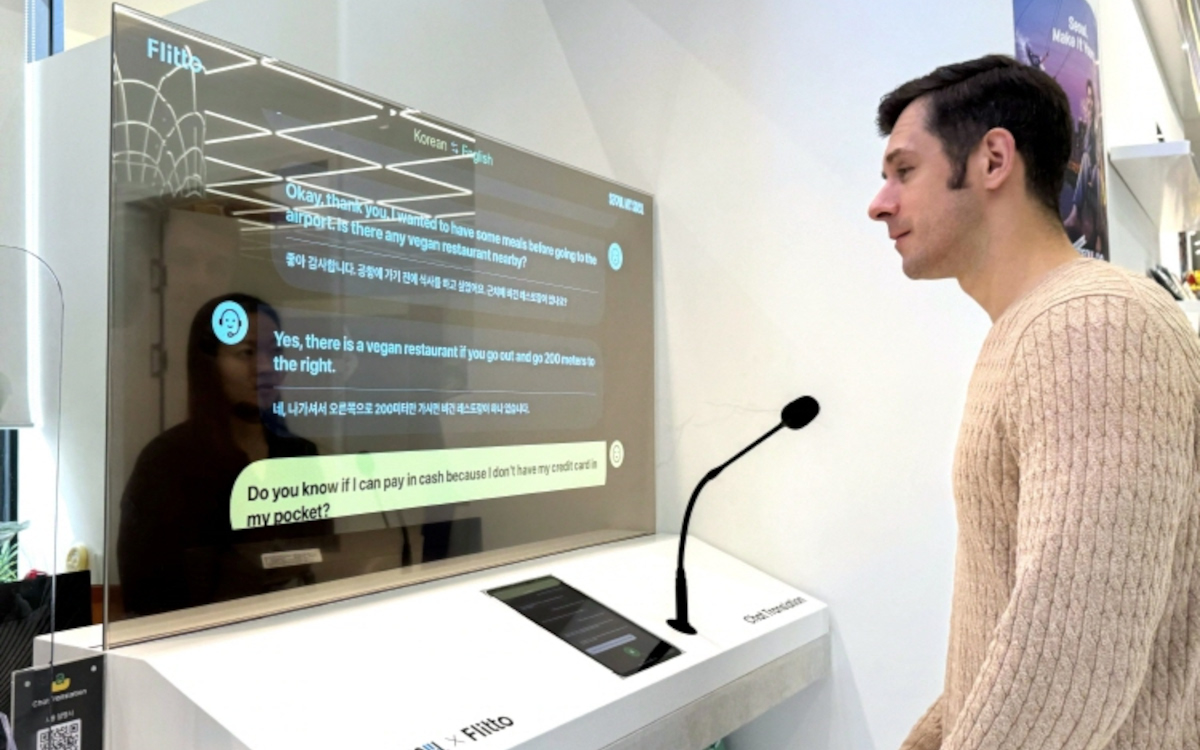
Simple. Gets the job done.
For the one millionth time, eye candy and Wow Factor stuff have Expiry Dates. The thrill goes, quickly. In a harried environment like a major airport, I tend to think travelers don’t need to be entertained in some fashion. They just need answers. Like NOW!!!
Side note: the holographic thing reminded me of past efforts by airports to address information challenges with eye candy. Longtime readers may recall my great love for what I lovingly called the Talking Flat Ladies, which used projectors and special 3M film. They always appeared to be broken or misaligned.
I suspect more than a few took a punch from irritated travelers.
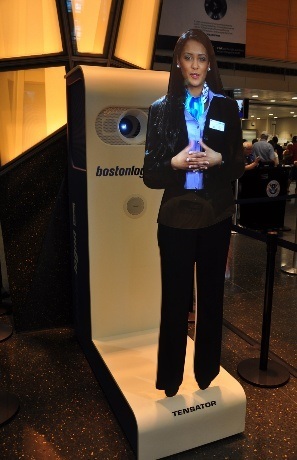
I don’t think I have seen one of these in years. One of the last times I was through Newark, for the hell of it, I monkeyed with the pico projector so it was pointed again in the right direction.
Maybe the DFW innovators, once the proposals come in, will have second thoughts. They’re absolutely right to apply technology to a problem common across just about any public facility – including hospitals. But the answer is not bling.
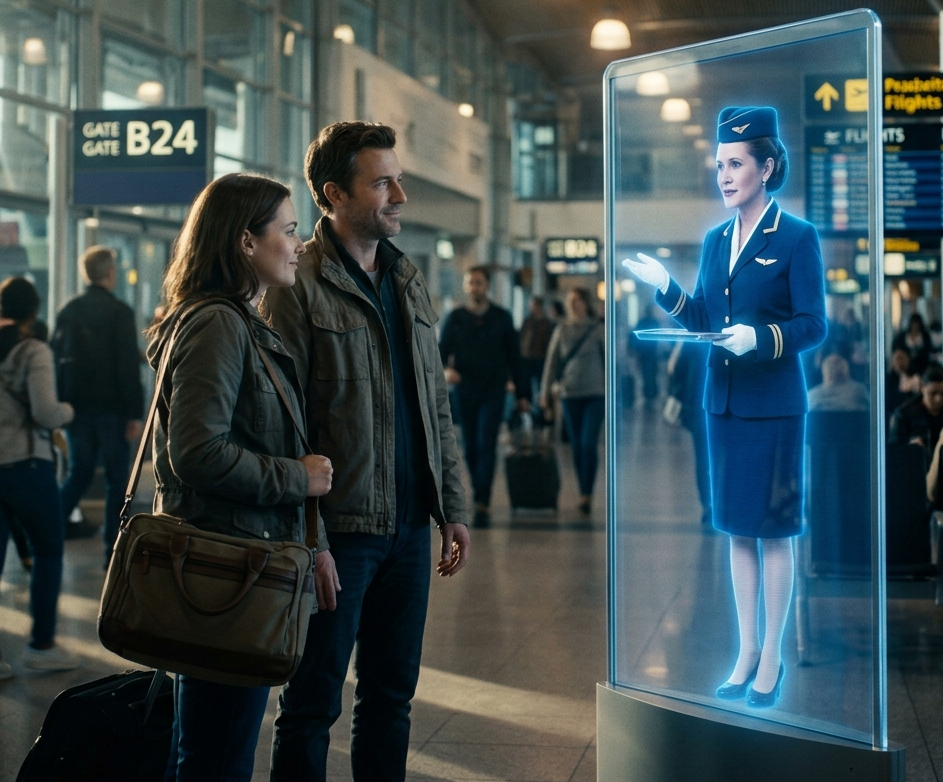
(Header image: AI generated)
Work with me Dave. I know you are familiar with Toronto Pearson, but it isn’t unique. International airports are indeed multi-lingual and multi-cultural. You know what else? They serve people who are operating on a wide range of time zones. Ya’d think that someone arriving off a long flight that only serves a little baggie of crackers might want to visit an airport concession and get some food or a drink. How about when we wait for a 10PM flight and everything is closed at 9PM?
What I’m getting at is that a 3D fakogram, should really help us feel better served and would be more cost effective than just keeping all airport concessions operating and staffed during operating hours.
Pearson, as one example, really doesn’t get their mission or opportunity and something like this will only lead them further astray. Gee whiz tech fixes everything!