

Will It Be ISE, Or AISE?
December 10, 2025 by Dave Haynes
ISE 2026 in Barcelona is now only a few weeks out, and it is time to start thinking about what I expect and want to see – those are not necessarily the same things – at the biggest ProAV trade show on the planet.
A little weirdly, ISE will be my first business event in many, many months – between trying to retire in May (which is only sorta working) and being among the many Canadians not traveling into the U.S. for reasons that are discussed 24/7 on news channels.
I was always going to ISE – retirement be damned. I want to keep my hand and brain in things, at least a bit. I want to see business friends who I only catch up with when I travel. And Nova Scotia in early February is an awesome place not to be, especially stacked up against sunny, coastal Spain. I think three years in a row we came home to piles of snow, and butt-ugly cold.

There will not be a Sixteen:Nine mixer, at least not one I organize (Spoiler from invidis: Yes there will be one! Watch this space). That event looks simple enough, but a mixer is one hell of a lot of work to pull off well. So now I get to just hang out in Barcelona, and mooch drinks and food at other people’s parties and dinners.
Presumably, Bryan Meszaros is doing one of his XUSC cocktail party events that week, so his thing will be the new default industry mixer. Unless someone else also does an event. Let me know. I’m free-ish.
For North Americans on the fence about going to ISE … go! This is no slight on Infocomm, but just about anyone I know who’s been to that show and then goes to ISE, pretty quickly says, “Holy shit!”
ISE is a lot bigger. The vendors are different and diverse. And the whole thing is an eye-opener for people who get out of whatever industry bubble they’ve been in. Americans, and to some extent Canadians, tend to think of themselves as the industry’s innovators. But once they cross an ocean, they get schooled. In just about every respect, we’re behind.
Then there’s the regional food. The slivers of iberico ham. The cava. Intriguing bottles of priorat, garnacha and tempranillo on the shelves of the store around the corner from my short-term rental. And the city’s remarkable architecture and street life.
This will maybe be my 10th time at ISE, even with a missing year or two when Covid got in the way. Here are some thoughts on what I expect to see at ISE this time around.
AI-A-Go-Go
PPDS was among the earliest big display vendors pushing out PR about its planned presence in Barcelona, and its marketers managed to work two AI references into the opening paragraph of its news release.
You should expect to see AI-powered, AI-ready, AI-driven, AI-forward, AI-infused, AI-enabled and on and on worked into most pre-ISE press material and then on the walls of stands and whatever paper is being handed out.
I asked Perplexity to AI-generate some goofy variables on the term, and I have a particular affection for one of them: neural-noodle-nudged. It also came up with circuit-clown-cranked, and that’s a good reflection of the powerful but imperfect state of late 2025 artificial intelligence.
A year ago, I expected to see a lot of AI at ISE, but didn’t. I got the same feedback from other people whose opinions are worth hearing.
There were AI bits here and there on the show floor, but on the hardware side it was stuff like AI upscaling. For the software, there was “well, that’s nice” stuff like AI-enhanced CMS content designers. They generally use AI that’s linked to public LLMs, to generate dubious images or screen layouts that look very much like what happens when people use PowerPoint for the first time and discover fun fonts!
One year on, AI’s core visual tools are MUCH better. But I’m not expecting to see a whole bunch that really pushes possibilities. The best bits about AI may well be functionality that works behind the scenes – agentic tools that do stuff like look for scheduling errors, or for processes and components that might be failing.
It’s boring, sure, but a hell of a lot more meaningful than, “Look how you can do a ChatGPT prompt and get a (crappy) eight-fingered image of an imaginary shopper in an imaginary store, without even leaving our UX!!!”
Awesome.
Expect to hear CMS companies talking a lot about agentic and propeller-head approaches like model context protocol. Think of MCP as a universal adapter and bridge between AI models and the information they need, like APIs, databases, files, and other services. Instead of AI apps each having their own custom integrations, MCP allows for a common way for things to happen.
If you want to see something for AV that’s interesting and in AI terms well established, look at Netspeek.
BTW, Erik D … respond to my emails, dammit 🙂
Display Specs Downplayed
At past ISEs, as LED started to catch up to and eventually pass flat panels in importance and sales, the display tech was marketed at first on pixel pitch and then on terminology that only display nerds understood.
Pixel pitch mattered when 1.9mm displays were considered jaw-droppingly crisp and amazing. They were insanely expensive. Now 1.9mm is almost a budget buying decision, given there is lots of product available that is 0.9mm or even tighter.
Vendor stands used to have their signature displays loudly indicating the pitch size, in big graphics. I noticed at last year’s ISE how some manufacturers had abandoned pronounced references to pixel pitch, because everyone had fine pitch product. Instead of big graphics, you needed to bend down and squint at the little fact tags off to one corner of a big screen.
Then it was microLED, and because I’m a life-long smart-ass, I’d poke at booth staff to convince me the products they were loudly proclaiming as microLED actually met the technical definition. Some marketers took the position that because the LED diodes were teeny, they were microLED. Well, no.
If you saw 20 LED displays at the last ISE that were billed as microLED, one or two actually were. The rest were Chip On Board (COB).
That noted, I don’t expect to see a lot of vendors loudly hollering about their microLED product, because the broader industry has seen how much less costly fine pitch COB displays look really spanking good.
The number of buyers who will write checks for $250,000 microLED displays, when same-sized ones that cost a third of that look every bit as good, is small. Large format microLED is probably going to be a niche for things like medical applications, where pixel density matters.
MicroLED displays look awesome, but I think they’re a niche product and potentially interesting for applications like transparent. But they have to get past the price problem. Transparent OLED also looks awesome but LG and other companies have struggled getting any marketplace traction.
I will also be intrigued by what the giant Chinese displaycos bring along for flat panels. Companies like TCL now manufacture HUGE flat panel TVs that are close to the same size as many of the All-In-One LEDs that are now sold into corporate spaces – and sold as kinda like big TVs, but much bigger. And LED!
If the costs are similar or lower than the LEDs, I think some integrators will slip into chin-scratching mode. Big. Familiar. Simple. Works like what’s at home. Et cetera.
Do they really need a lower rez LED?
How Much E-Paper?
There were many, many, many companies last year showing their adapted and mildly tweaked versions of E Ink’s two larger format color e-paper displays, Spectra 6 and Kaleido. It was the shiny object of the display side of the 2025 show.
My safe guess is that there will be more of that in a few weeks, but I get almost no sense that this technology is much more than an active talking point and still-shiny object for manufacturers that have hit an innovation wall with their more conventional products. It’s hard to get Oohs and Aahs showing off higher refresh rates.
Unless most or all rollouts have PR blackouts imposed by customers, I’ve seen very little indication color e-paper displays are being purchased and used in significant numbers. When a deployment of 8-10 units gets a case study, that’s a tell.
I like the technology, but the same form factor of color e-paper display can cost 8X that of an LCD that has much better color reproduction and supports full video. Companies want to communicate and show their green efforts, but I’m not sure they’ll pay e-paper’s price right now.
Color e-paper’s display future is most likely, when costs drop substantially, in replacing printed posters in retail windows. If the TCO equates to the cost of printing, putting up and swapping out posters several times a year, that’s when it will happen. But replacing print is a sign industry thing, not AV. Using e-paper for most digital signage applications makes little or no sense.
Example – E Ink is testing video support, but if video runs on a color e-paper display, the batteries that are a key selling point will last hours, not months.
E-paper may also have a role in digital OOH, taking over from energy-hungry, delicate high-brightness LCD totem displays. But color reproduction is an issue, as is (broken record time) price.
I continue to wonder why reflective LCDs have never gained any traction, as they offer some of the same benefits of color e-paper, but do full video and cost much less.
Eye candy
I’m always curious what LG comes up with as the showstopper feature at the gateway to its ISE stand. It tends to be someone else’s technology – like kinetic LED walls – that is almost entirely there just to get attendees to stop and look. And that works.
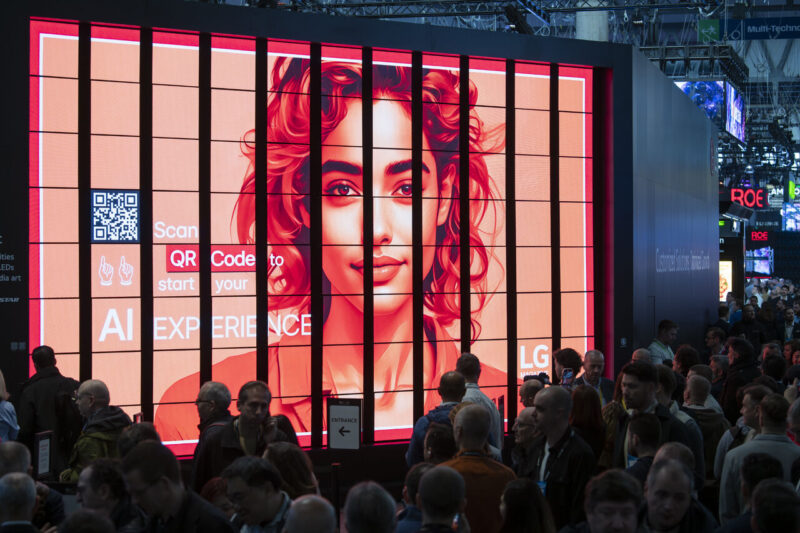
Maaaaaybe someone – thinking an emirati in Dubai with lotsa money but not lotsa smarts – buys one of them. But no one at LG has a sales quota to hit on these things. At least I hope not.
I’m kinda curious about a couple of hologram-ish products, like a glasses-free 3D thingie from NYC-based Looking Glass. I dunno if they will be at ISE, however.
Samsung has what looks to be a similar thing, though bigger. A “spatial” display that is only 52mm thick, or about 2 inches. That’s MUCH thinner than the shower stall-shaped transparent LCDs on the market that get called holograms (they’re not).
There will also, undoubtedly, be variations on neural-noodle-nudged (I got to use it!) avatars working as on-screen bots. I don’t get the point. But I’m in my curmudgeon years, so maybe I just don’t understand.
Walk The Show Floor Edges
Walking the main halls and seeing the largest stands from big electronics brands is a must-do at ISE. But I always encourage people who are there to get a sense of what’s coming to walk the edges and backs of the big halls, and pay attention to the legions of little tabletop stands and mini-booths set up along the ground level concourse.
These tend to be budget-constrained start-ups or companies turning up at ISE for a first time, either unable to book more prominent space or wanting to sniff out the value before spending real money.
I have found, year after year, some interesting tech from companies I didn’t know existed. I’ve also found some huge guys like China’s BOE at the back of big halls – there either by choice or because smaller competitors who’ve been showing for years get first crack at more premium spots. Typically, a show like ISE is selling the next year during the show, with vendors re-booking the same location or hoping to get better space should it open up.
Walking the edges of ISE also gets you out of halls quicker. The mobs are thinner. In past years, I have walked the edges and looked for side exits, as by later afternoon, I haven’t had the energy for one more conversation. Subway. Flat. Quiet beer.
THEN I’m ready for more.
Practical Advice For Newbies
Stay centrally, or at least away from the convention hall. The area around the Grand Via is pretty industrial and charmless, in a city that is seriously charming. But you don’t need to be right in the tourist zone either. A little YouTubing will point you at different neighborhoods like Gracia, which is gorgeous and almost tourist-free.
Take the subway. Taxis and ride-shares to and especially from the venue are a bit of a nightmare unless you travel away from the opening and closing times. The subway is fast and easy, and you’ll be fine without much or any Spanish language skills. Plus transport is free: All ISE 2026 attendees and exhibitors get a free five-day travel pass for the Barcelona train, metro and bus systems. You pick up the paper pass card at the main entry hall by showing your badge.
Comfy shoes. It’s a trade show, so obviously there’s a lot of walking involved. At ISE, it’s a LOT of walking to get to the building and then to the halls.
Bring energy bars or lotsa money. The food stalls at the venue are “You’ve gotta be f*cking kidding” expensive, but on the other hand, they’re diverse and there are some great options. There are outside areas between some of the halls that have food trucks, and last time I had an amazing, life-saving local sausage on a crusty bun outside that made me so happy enough I forgot the silly price.
Plus I think there was a cold Estrella in the mix.
Don’t show up an opening day right when the show first opens. Just don’t. Mass of humanity stuff.
Some halls open early, at 9 – like the one with the big display guys. The digital signage hall opens at 10.
Happy Travels
If you are going to ISE, safe travels and I will see you there. I am normally in bat-out-of-hell, must-see-everything mode at this thing, but semi-retired me will be moving slower and more able to stop and shoot the breeze.
I love the way you write Dave, keep doing what you know and do best and see you in Barcelona, Bravo!!
Great write up Dave – looking forward to discussing E Ink applications and seeing you in Barcelona!