


Burn Baby Burn – Shadow-less Signage
August 27, 2025 by guest author, Florian Rotberg
Operating digital signage screens in direct sunlight is one of the industry’s biggest challenges. Unshaded installations like drive-thrus or curbside DooH/Smart City kiosks are especially vulnerable to by burn-in, particularly if they are not sufficiently cooled. High-brightness digital signage screens are often pushed to their limit.
Last summer, we checked how high-brightness screens are faring in the searing heat of Texas. This August, we visited Florida – and the results are again disappointing.
Heat-damaged screens are a common sight in drive-thru lanes at QSR restaurants. Many digital signage displays are installed without adequate protection from direct sunlight or proper thermal management. As a result, temperatures between the protective glass and the display panel can soar above 80°C (176°F). Prolonged exposure to such heat gradually degrades the LCD crystals, leading to visible damage. In severe cases, screens develop brown spots resembling measles; more often, they show widespread brown discoloration that, while less dramatic, still significantly compromises image quality.

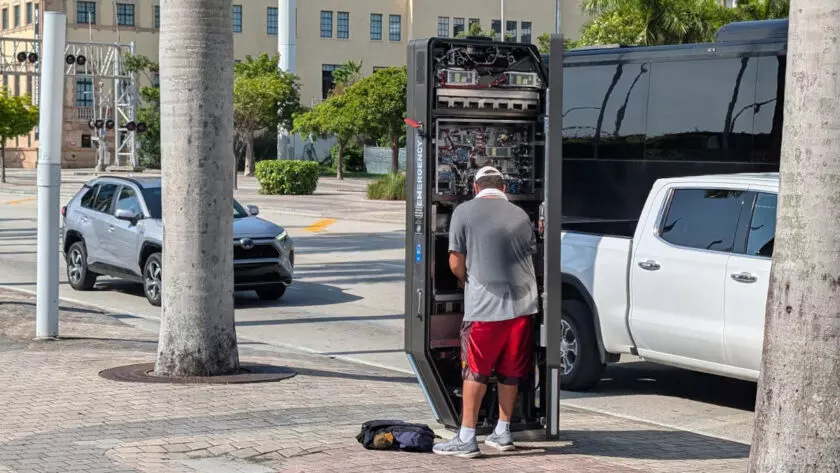
IKE kiosk in Miami (Images: invidis)
Purpose-Built Outdoor Displays Engineered for All Environments
In addition to choosing high-brightness, IP-rated screens, proper cooling is essential to ensure years of reliable, trouble-free operation. While looking at outdoor digital signage in Miami, we came across an IKE DooH Smart City totem undergoing maintenance – a visibly sweaty job, even at 9 a.m. in the morning.
IKE totems can be found everywhere in downtown Miami and Miami Beach. The Beach Screens even feature a wave design. The kiosks are developed and manufactured by Dynascan. The differences to QSR totems are visible at first glance – the structure is more ruggedized and designed to withstand the elements. Operational stability and quality require more than a bonded outdoor display in a minimal housing.
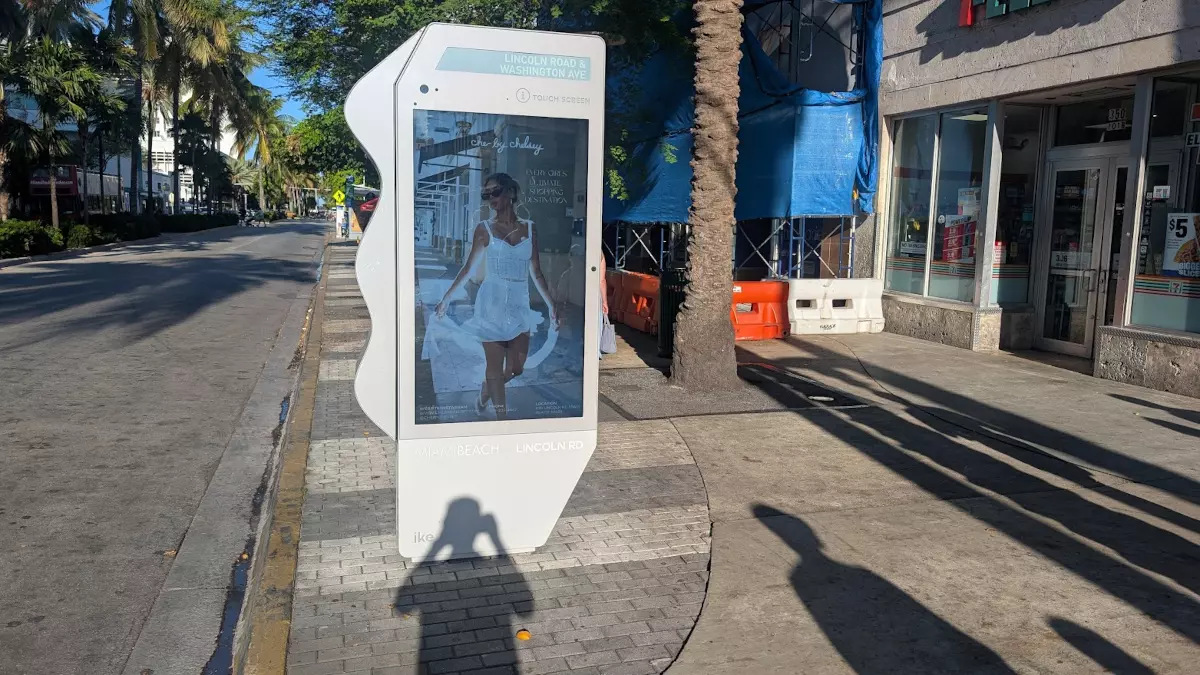
IKE kiosk in Miami (Images: invidis)
Well-designed kiosks maintain constant airflow between the display and the protective glass, ensuring efficient thermal management of both solar heat and the panel’s own waste heat. Dynascan has developed a filterless thermal management system, whereas others rely on energy-intensive heat exchangers.
The simplest way to keep outdoor screens in operation for a long time remains a canopy above the screen to provide shade. If a canopy is not an option, outdoor totems with proper thermal management are the solution.

Outdoor Projector at Bayfront Miami (Image: invidis)
Encapsulated Projector for Visitor Experience
The challenges of outdoor operation in subtropical Florida are also evident in this permanently installed projector at central Bayfront Park. Its weatherproof housing is sealed against water and dust but still requires external cooling. The stand and ground mount are reinforced with heavy-duty screws, ensuring it remains secure and protected against the next tropical storm – which could strike at any time.

Outdoor Screen at Miami Art District (Image: invidis)
Florian, I have had more than my share of dealing with outdoor screen issues, I agree that for LCD screens using a shade canopy is probably the best solution. In my previous company we tested the surface temperature of a 65″ panel that was in direct sunlight, and it measured over 98 degrees Celsius which exceeds any manufacturer specifications. We are now working on developing LED display alternatives that have proven to withstand these extreme temperatures.