

How To Stop Competing On Price And Instead Own A Niche – In This Case Construction Sites
March 23, 2026 by Dave Haynes
There’s a lot going on at commercial construction sites, and a lot of opportunity for things to go wrong – with consequences varying from delays and cost overruns to injuries and even deaths. So it is the kind of environment that can really benefit from clear and evident visual communications – like what digital signage makes possible and easy.
I was intrigued seeing a LinkedIn post the other day from a UK company called Hard Hat Media, which very plainly says its thing is “Digital Signage For Construction.”
What the company does is what I have been nattering on and on about for years: they resolutely focus on a vertical market and tune their products, marketing and sales to just that market. I’ve suggested endlessly that software and solutions companies that go to market with a general offer – or decide to compete in a super-crowded sector like retail or QSR – are going to struggle to thrive or maybe even survive.

I’ve got MUCH more enthusiasm for small companies that look around – or look inward at their skills, experiences and book of business – and then clearly define that they are the “go-to people” for a niche vertical that has some scale. My poster child for this approach is a US company, First Arriving, that JUST does digital signage and related digital solutions for first responders like community police, fire and EMS departments.
Based in Berkshire, west of London, Hard Hat Media was founded about 15 years ago by a guy who was a commercial construction manager for many years and saw a market need for better ways to communicate safety, health and environmental messaging to the day-to-day on-site workforce. That experience is important, just in the same way solutions companies succeed or fail based on how much or (too often) how little they actually know about the detailed workings of verticals like retail or hospitality.
Hard Hat Media’s digital signage products, the company says, deliver up to date and accurate information to the workforce, moving away from outdated, tattered posters on noticeboards or emails that don’t get read. Digital signage is a dynamic and easy way to send internal communications. All our products are specifically designed with the construction industry in mind.
The products range from ruggedized high-bright LCD totems and LED displays for hoardings to interactive screens and TV-like set-ups in break rooms. They also do content. I don’t know the company, but from what I can tell online, the products are available to rent. That’s probably critical for a lot of jobs, though I am guessing there are some larger construction firms that could afford to purchase and own the gear and would have a steady use for those screens from project to project.
I went a little cross-eyed trying to dig up a good number that reflects the scale of commercial (excluding low-density residential) construction in the U.K. I gave up, but it is safe to assert the number of building projects would be in the 1,000s. So it is a vertical that offers scale, which is critical. It is also very helpful that safety and health messaging on job sites is not just a best practice – it’s mandatory. There can be everything from stop work notices to fines and even jail terms for serious infractions.
As always, if the pitch is for something that’s a need to have, as opposed to just a nice to have, it can be easier to sell and close.
Of course, a lot of that signage is evergreen stuff about wearing hard hats, safety boots and hi-viz vests, which can be printed and posted once and doesn’t really need digital. But there would be all kinds of information that is more fluid and data-driven to get reliably and repeatedly in front of workers on job sites. I am guessing if email open rates are feeble in a lot of white collar workspaces, they’d be even worse for construction sites, given what they do and how many are probably just contractors, not direct employees.
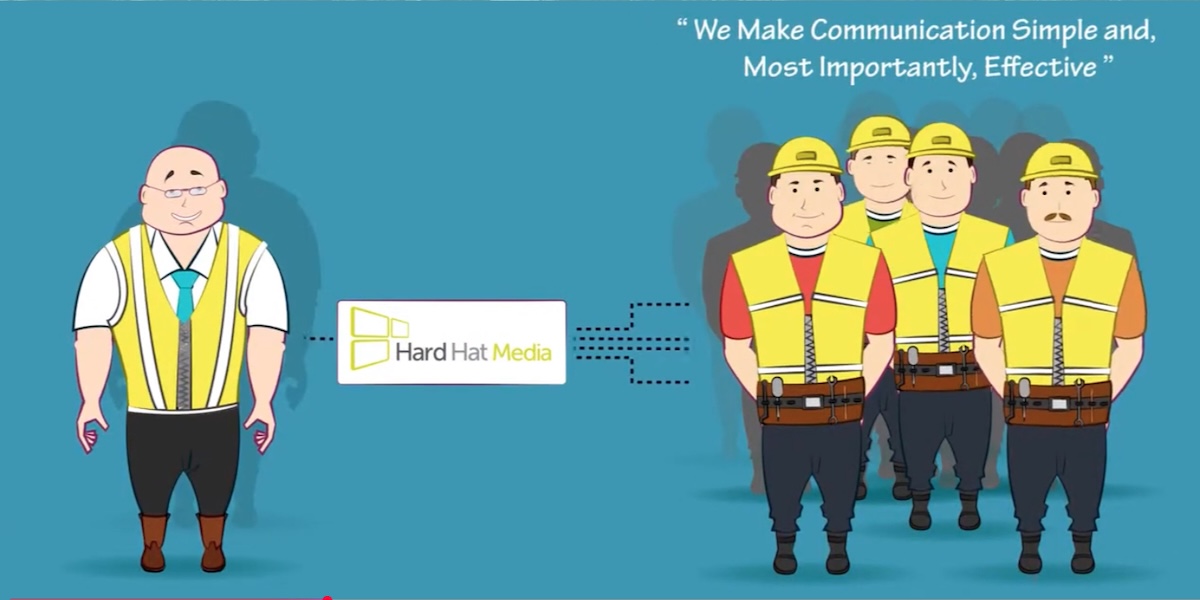
Here’s an explainer video …
I like the approach, and am curious if there are variants of it in other countries.
At the same time, I can’t let go on the content shown around the company website. It’s very 2006 – using the zones available in whatever CMS is running, and loading up screens with far too much information.
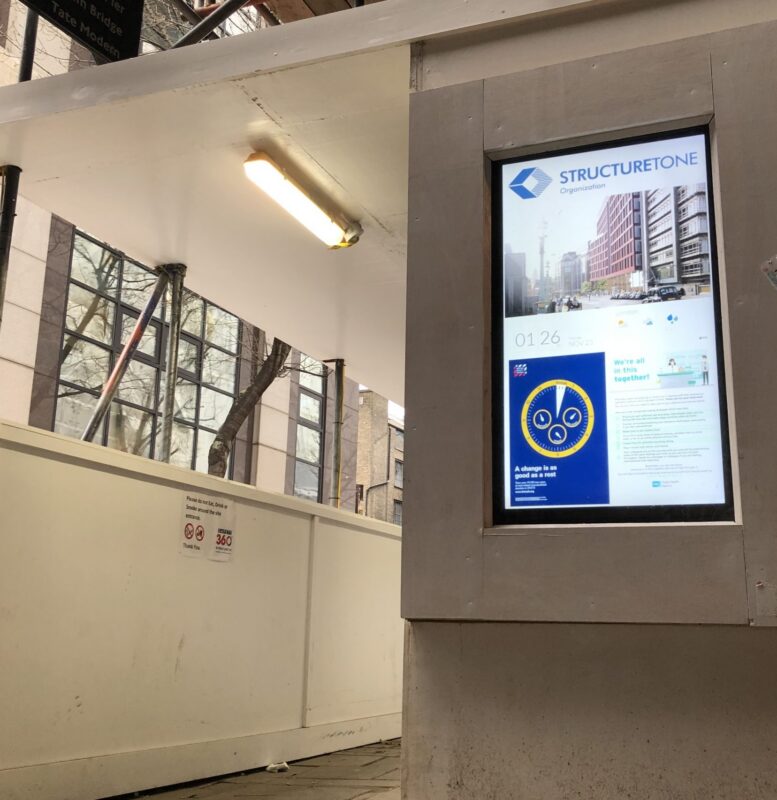
(Image: Hard Hat Media)
Just because it is more than possible to put all kinds of different things on a screen at once doesn’t mean it is a smart thing to do. Instead of putting five elements in one jammed layout, try cycling through those five things in a repeating loop. Visual clutter is deadly – as research strongly suggests that when a screen is crowded with too much information, people often stop looking, just skim, or they fail to process the content properly.
Has this company cracked the code on servicing this vertical market. Dunno. I don’t possess anywhere near enough knowledge of how all that works, and the marketplace’s dynamics.
But what I do know is that this at minimum offers insight on developing a company and product offer expressly tuned to a vertical market and clear use-case, versus what I STILL see far too often – companies that develop general purpose solutions, who then struggle to compete because they’re just selling based on things like ease of use and low price.
You really want to be the go-to people for something, like a Broadsign is for DooH, Uniguest is for the hotel sector, Synect and Omnivex are for airport comms, and so on. If you’re general or competing with a mob of other companies, you’re often going to win and lose on price – and it’s pretty rare when the high bid gets the nod.
(Images: Hard Hat Media/Screenshots)
Great to see Anthony and the Hard Hat Media team getting the positive attention they deserve.
As you say, Dave, a really good example of going deep and dominating a specific market and use case.